 Thistle & Seam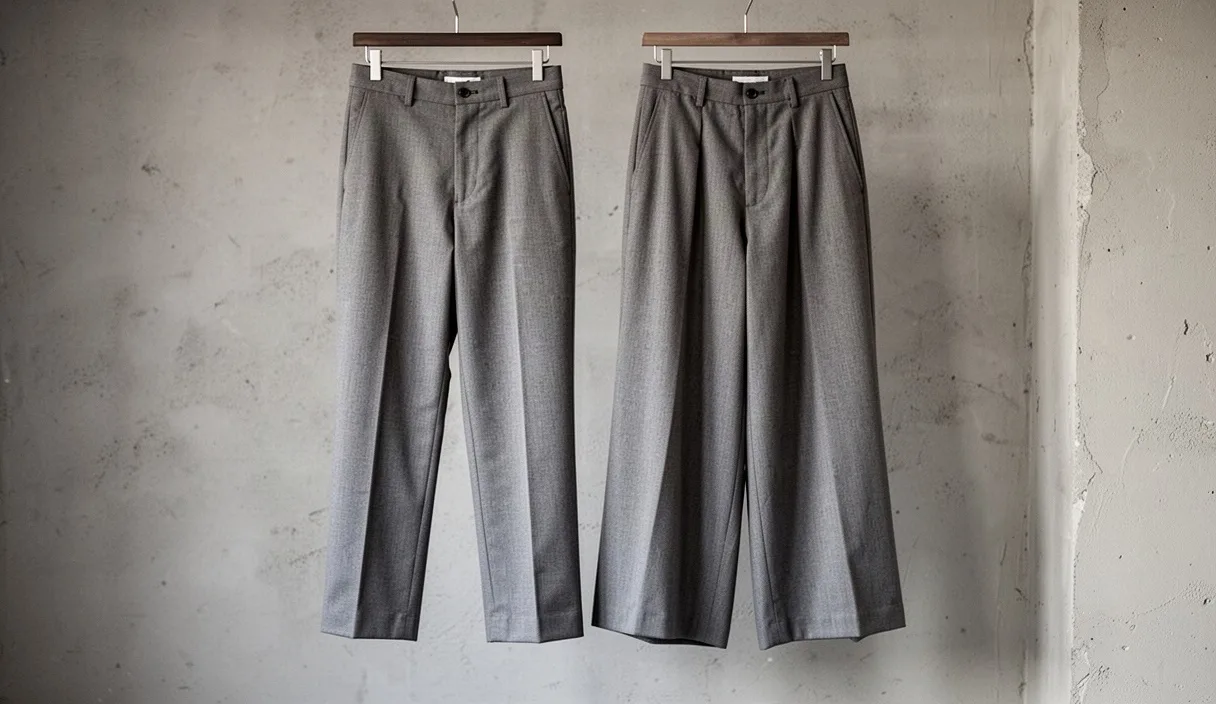

Stand in front of a mirror wearing jeans, then try on a pair of wide-leg trousers, and you will notice something odd: your legs look longer in one pair and shorter in the other, even though your actual height has not changed by a single inch. This is not an illusion created by fabric or fashion magic. It is proportion, the same principle that makes a tall vase look elegant on a narrow table but awkward on a wide one. Trousers work the same way against the "table" of your own body.
Choosing between straight leg and wide leg trousers is really a question of how much visual space you want your legs to occupy, and where you want the eye to pause. This article breaks down how each cut behaves on different heights, why waist position and trouser break matter as much as the leg shape itself, and how to use a short fitting room checklist so you are not guessing under store lighting.
What Proportion Means on a Pair of Trousers
Proportion, in clothing, is simply the ratio between the length of your torso and the length of your legs as it appears to someone looking at you. It has little to do with your actual height in inches. A person who is 5'4" with a shorter torso can visually read taller than someone who is 5'9" with a long torso, because more of their body "budget" is spent on legs.
Trousers change this ratio because they add a second shape on top of your leg's natural one. Straight leg trousers follow close to the width of your leg from hip to ankle, so they add almost nothing to the silhouette, like drawing a straight line next to another straight line. Wide leg trousers add fabric volume that flares outward, which is closer to drawing a triangle next to that same line; the eye now has more surface area to read, and it reads "leg" as a bigger, sometimes shorter-looking block.
A simple kitchen comparison helps here: think of a tall, narrow glass of water versus a short, wide tumbler holding the same amount of liquid. The narrow glass looks taller because there is less width competing with the height. Straight leg trousers behave like the narrow glass. Wide leg trousers behave like the tumbler, not because they make you shorter, but because they give the eye more width to measure against your height.
How Straight Leg Trousers Interact With Different Heights
Straight leg trousers keep a consistent width from the knee down to the hem, usually somewhere between 7 and 9 inches across at the opening depending on the size. Because that width does not increase near the ankle, the leg line stays visually unbroken, which tends to read as length no matter whether you are 5'1" or 6'2".
On shorter frames, roughly under 5'4", straight leg trousers tend to work best when the hem sits at or just above the top of the shoe, around the ankle bone. This avoids pooling fabric at the foot, which is one of the most common ways a straight leg trouser visually "eats" height. On taller frames, there is more room to experiment with a slightly longer break because the extra leg length can absorb a bit of fabric slack without looking bunched.
For a petite frame, a cropped straight leg, hitting an inch or so above the ankle, often outperforms a full-length one because it exposes a small amount of ankle, and bare skin reads as a continuation of the leg line rather than an interruption. A 5'3" person wearing a straight leg trouser cropped to the ankle bone, paired with a flat shoe, will generally look leaner through the leg than the same person wearing the identical trouser puddling over the foot.
On a 6'0" frame, the same cropped length can look slightly short rather than intentional, so a full break, where the fabric just touches the top of the shoe, usually looks more proportionate. The rule is not about a universal "correct" length, it is about matching the amount of visible leg to the length you already have.
How Wide Leg Trousers Change the Silhouette
Wide leg trousers typically measure 10 to 14 inches across the hem, sometimes more in a palazzo-style cut, and that extra fabric moves with the body rather than tracing it. This creates a column effect, similar to how a long curtain panel makes a window look taller even though the window itself has not grown.
On taller frames, this column effect tends to read as elongating, because there is enough vertical distance for the fabric to swing and settle before it reaches the floor. A 5'10" person in wide leg trousers that graze the top of the foot often looks longer-limbed than the same person in a fitted straight leg, because the uninterrupted vertical sweep draws the eye from waist to floor in one motion.
On shorter frames, wide leg trousers can still work, but the margin for error narrows. If the hem is even half an inch too long, the trouser pools at the shoe and visually shortens the leg, in the same way a rug that is slightly too large for a room makes the room look smaller rather than larger. A 5'2" person generally needs a wide leg trouser hemmed to just above the shoe, with a slight break at most, and often benefits from a higher rise to compensate for the extra width below.
Fabric weight also matters more in wide leg cuts than in straight leg ones. A heavy, stiff fabric holds its triangle shape and can look boxy on a shorter frame, while a lighter, fluid fabric drapes closer to the body's natural lines and is more forgiving at almost any height.
The Role of Waist Height and Trouser Break
Waist height, meaning where the trouser sits on your torso, changes the leg-to-torso ratio before the leg shape even enters the picture. A high-rise trouser, sitting at or near the natural waist, shortens the visible torso and lengthens the visible leg line, regardless of whether the leg itself is straight or wide. A low-rise trouser does the opposite, adding visible torso length and shortening the apparent leg.
For someone shorter than average, a high-rise waist paired with either trouser style usually creates a more balanced line, because it gives the leg more visual real estate to work with. For someone with a long torso and shorter legs regardless of overall height, the same high-rise principle applies even more directly, since it is correcting a ratio issue rather than a height issue.
Trouser break refers to how the fabric falls at the ankle: a full break means the fabric folds once or twice over the shoe, a half break means it just touches the top of the shoe without folding, and no break means the hem sits above the ankle bone with a visible gap.
- No break: best on straight leg trousers for shorter frames, exposes ankle, reads as lengthening.
- Half break: safest universal choice for both straight and wide leg trousers, works across most heights.
- Full break: more forgiving on taller frames, can shorten the look of the leg on anyone under about 5'5".
Matching Trouser Style to Shoe Style
The shoe is not an afterthought here, it is part of the same visual line as the trouser hem, which means the wrong shoe can undo a well-chosen trouser length in seconds. A flat, thin-soled shoe under a wide leg trouser tends to disappear from view, which works well on taller frames but can make shorter frames look like the leg simply stops at the floor with no transition.
A trouser with a half break paired with a shoe that has at least a small heel, even half an inch, tends to add length without looking dressed up, because the heel lifts the hem line slightly off the ground and keeps the fabric from pooling. This matters more for wide leg trousers than straight leg ones, since the extra fabric volume has more room to collapse at the ankle.
| Trouser Style | Best Shoe Type for Shorter Heights | Best Shoe Type for Taller Heights |
|---|---|---|
| Straight leg | Pointed flat or low heel, same tone as trouser | Flat, loafer, or sneaker |
| Wide leg | Small block heel, hidden under hem | Flat sandal or low heel, visible toe |
Matching the shoe color closely to the trouser hem, within one or two shades, also helps, because a strong color break at the ankle visually cuts the leg line in half, which works against the lengthening effect of either trouser style.
A Fitting Room Checklist Before You Decide
Store mirrors and lighting can distort proportion, so a short physical checklist is more reliable than a glance in the mirror alone. Walk through these steps before deciding on a size or style.
- Stand in the shoes you actually plan to wear with the trousers, not the shoes you arrived in, since heel height changes the hem's position by an inch or more.
- Check the hem at both a standing position and a slight step forward, since fabric behaves differently in motion than when you are standing perfectly still.
- Pinch an inch of fabric at the waist; if you can comfortably pinch more than two inches, the rise may be sitting lower than intended and changing your proportion.
- Look at the side profile, not just the front, since wide leg trousers can look balanced from the front but boxy from the side if the rise is too low.
- Sit down for a moment; if the waistband digs in sharply or the wide leg fabric bunches at the knee, the fit is likely off regardless of how the length looks standing.
Common Mistakes
One frequent mistake is buying a wide leg trouser one size up "for comfort," which adds width exactly where the silhouette already has the most fabric, making the triangle shape wider rather than longer. Another is hemming straight leg trousers to the floor on a shorter frame, which removes the ankle break point that signals where the leg ends and the foot begins. A third is assuming trouser rules apply identically to every fabric; a stiff denim wide leg behaves very differently from a soft crepe wide leg, even at the same measurements, so it is worth handling the fabric before trusting the size chart alone.
Next Steps
If you are unsure which category you fall into, start with one straight leg and one wide leg trouser in a similar neutral color, try both with the shoes you already own, and photograph yourself from the front and side in natural light rather than relying on a fitting room mirror. If hemming is involved, a tailor can adjust the break by small increments, often a quarter inch at a time, which makes a noticeable difference on wide leg styles in particular. For anyone making a significant alteration to a garment, it is reasonable to ask the tailor to pin the hem at two or three lengths and step outside the shop briefly to view it in daylight before committing to a final cut.